
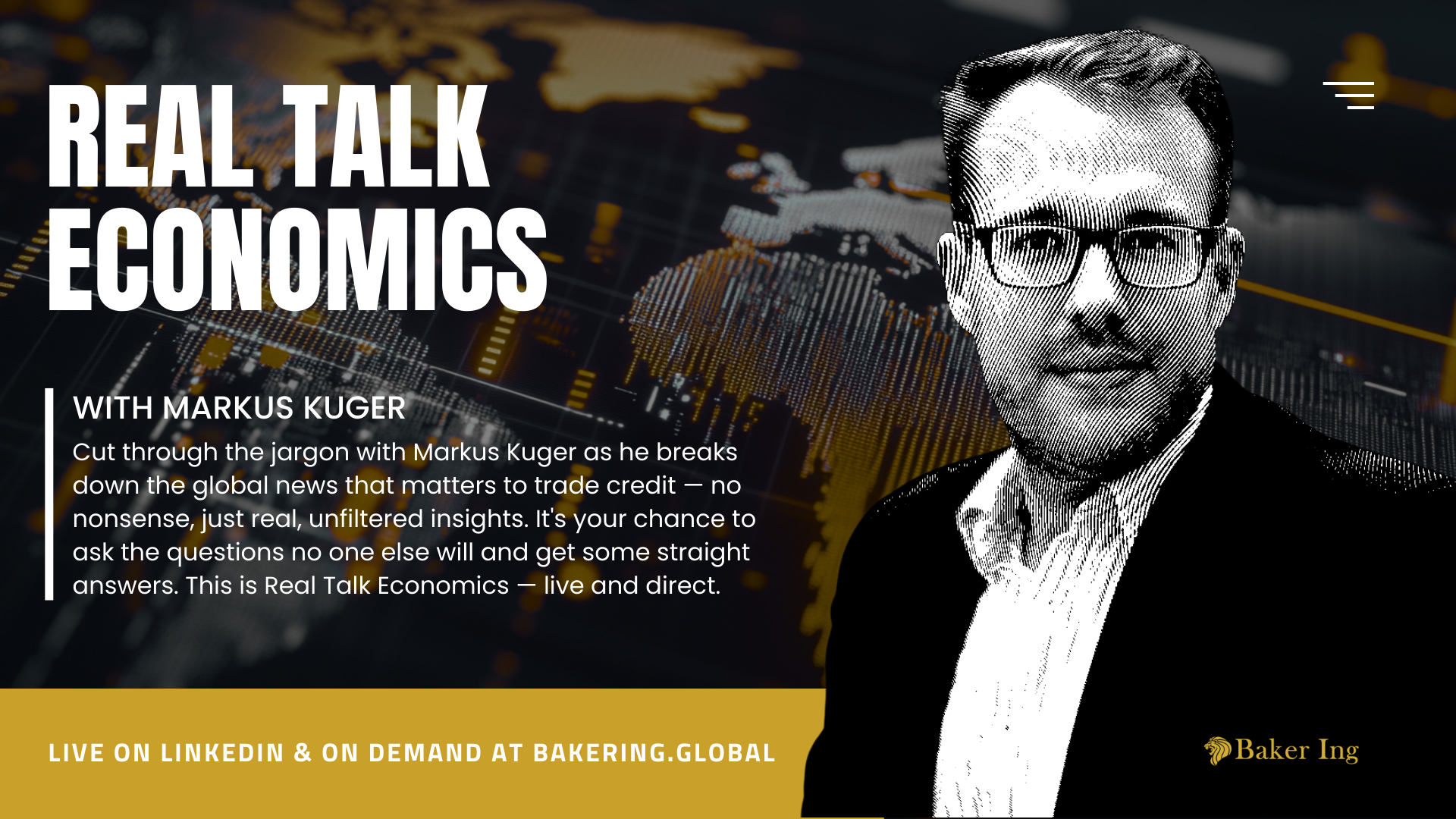
Episode 11: October 2025
Real Talk Economics: October 2025 Briefing
Freight costs ease. Policy risk persists. Credit risk stays elevated.
Theme: Cost relief on the surface. Exposure rising in the ledger.
Why This Briefing Matters
Headline relief does not secure the cash cycle. Receivables teams face a mix of easing freight, sticky services inflation, and policy volatility.
- Freight costs eased. Delay risk still erodes margin and DSO.
- Default risk stays elevated with a shift toward smaller failures.
- Pricing and terms require faster review cadence under policy shocks.
- Cost of capital declines slowly from a high base. Lending standards move only modestly.
- Europe’s sector mix and softer employment read-through to O2C exposure.
Key Questions Answered
- How should a one-week delay be priced into margin, credit terms, and proof-readiness targets?
- Which European sectors show improving orders despite weak output, and how should exposure be routed?
- What do UK labour signals imply for collections cadence and escalation timing?
- Where should exposure caps, dispute codes, and escalation logic move first under persistent risk?
- What do recent trade agreements and tariff announcements imply for Q4 to Q1 planning and cross-border terms?
Session Highlights
Macroeconomic overview
Global PMIs improve. Europe lags on output and employment. UK inflation remains above target with services as the driver. US inflation edges higher on tariff effects. UK credit availability improves as borrowing costs decline from peak levels.
Credit risk signals
England and Wales hold at a high plateau through July. Germany posts double-digit insolvency growth with smaller cases reducing average claim size. Global insolvency trajectory remains above the 2016 to 2019 average with forecasts of +6% in 2025 and +3% in 2026.
Payment performance
UK advances to the top tier in Europe at 11.7 DBT. France shows a partial improvement yet remains risk-heavy. Southern and Eastern Europe continue to face longer delays.
Supply chain watch
Container costs normalise after mid-year spikes. The global pressure index sits near average. Maritime remains the backbone of EU freight by share. EU ETS phase-in begins to lift logistics costs.
Trade and policy risk
Uncertainty indices remain elevated despite recent agreements. Ad hoc measures continue to shift pricing and planning cycles.
Access the Recording
Complete the form to watch the full October 2025 session. Already registered? Confirm your email for instant replay access.
Next Episode: Wednesday 5 November 2025, 12:30 UK / 13:30 CET
Episode 10: September 2025
Real Talk Economics: September 2025 Briefing
UK Treads Water — Micro Friction Rises. Credit Risk Holds at Elevated Levels.
Theme — Stability on Paper, Strain in the Ledger
UK GDP is holding up — but signs of underlying stress are now widespread:
- GDP grew +0.3% q/q
- Business investment fell –4% over the same period
- Retail sales volumes remain below pre-COVID levels
- Job vacancies have halved since their 2023 peak
- Inflation is back at 4% — double the Bank of England target
- Consumer confidence remains low; services PMI positive, but construction and manufacturing weak
- Access to credit remains tight — despite falling interest rates
- UK now ranks 3rd in Europe for payment punctuality — outperforming the EU average
- EU payment delays worsening; France shows a tentative recovery
- Insolvencies flat in England & Wales (H1); rising across EU
- US tariffs remain near 20% — but legal uncertainty is rising after a recent court ruling
Why This Briefing Matters
Headline stability hides rising operational risk. Receivables teams face conflicting signals on confidence, credit access, and policy.
- Growth isn’t driving spend
- Tariff effects are still feeding into costs and payment friction
- Default risk remains elevated — but uneven
- Lending remains constrained — even as rates fall
- Macro is stable, but micro stress is building by sector
Key Questions Answered
- What do the US–UK and EU–US trade deals really mean for exporters and B2B terms?
- Is the UK’s payment performance a lasting trend — or a short-term outlier?
- Where is margin pressure building fastest — and how are firms reacting?
- What does the sharp drop in job vacancies tell us about the labour market’s direction?
- Should credit teams adjust exposure caps or escalation logic first?
Session Highlights
Macroeconomic Overview
UK GDP holds at 0.3%, but private investment, confidence, and vacancies all trending down
Credit Risk Signals
Insolvencies flat in England & Wales; EU shows renewed deterioration
Allianz Trade forecasts remain at +6% for 2025, +3% for 2026
Payment Performance
UK moves into top 3 for prompt payment in Europe
France stabilises — but Southern and Eastern Europe continue to deteriorate
Trade Risk
US effective tariff rate ~20%; legal challenges introduce new policy uncertainty for Q4
Access the Recording
???? Complete the form to watch the full September 2025 session. Already registered? Confirm your email for instant replay access.
Next Episode: 1st October 2025
Episode 9: August 2025
Real Talk Economics: August 2025 Briefing
Signals Improve — Base Was Weak. Credit Risk Holds Steady at Elevated Levels.
Theme — Measured Recovery, Operational Implications for Credit & Collections
- US consumer confidence posts its first rise in six months — with political bias distorting sentiment surveys.
- Composite PMIs edge higher in the US and Eurozone; Global Manufacturing PMI dips below the neutral 50 mark.
- US effective tariff rate now ~17% — down from April’s 24% peak, far above last year’s 2–3%.
- England & Wales insolvencies fall 16% y/y in June, yet H1 totals remain flat.
- IMF upgrades global growth to 3.0% and UK to 1.2%; forecasts a 7% drop in energy prices for 2025.
- Inflation divergence: Eurozone on target; UK at highest since Jan 2024; US on a gradual upward path.
- Interest rates falling into H2 from elevated levels; UK banks anticipate modest easing in credit supply.
Why This Briefing Matters
- Improvements are real but measured against a soft base — credit exposure strategy still needs discipline.
- Tariff adjustments will filter through to landed cost, margins, and payment cycles as H2 stockpiles unwind.
- Business failures remain high by historical standards; sector- and jurisdiction-specific risk mapping remains critical.
- Credit conditions may loosen but from a tight starting point — escalation protocols and exposure limits should be stress-tested now.
Key Questions Answered
- Which markets are turning stronger sentiment into actual payment performance?
- How will a sustained 17% US tariff environment impact PO flow, pricing, and DSO?
- What sectors are showing widening gaps between confidence and cash conversion?
- Where should credit teams adjust first — exposure caps, dispute protocols, or escalation triggers?
Session Highlights
- Macroeconomic Outlook: IMF lifts global GDP forecast to 3.0%, US and China see largest upgrades.
- Tariff Impact: US rate down from April peak but still historically high; operational consequences for H2 cashflow.
- Credit Risk: Allianz Trade projects +6% global insolvencies in 2025, +3% in 2026 — elevated risk plateau continues.
Access the Recording
???? Complete the form to watch the full August 2025 session. Already registered? Confirm your email for instant replay access.
Next Episode: 3 September 2025
Episode 8: July 2025
Real Talk Economics: July 2025 Briefing
France in Focus — Credit Stress, Political Instability & Structural Drag
- The US dollar posts its worst H1 since 1973 as investor confidence in Trump’s fiscal policy fades.
- France faces sharp rises in payment delays and insolvencies — with 1 in 12 invoices paid over 90 days late.
- Political fragmentation drives economic paralysis: four prime ministers in 18 months, and no reform path in sight.
Why This Briefing Matters:
- France’s business environment is deteriorating: prompt payments drop below 50% and insolvency levels continue to climb.
- UK inflation eased in May — but remains higher than EU and US benchmarks, limiting policy flexibility.
- Real wage growth improves, but margin pressure is building across sectors as input costs rise faster than output prices.
- Shipping costs, trade policy volatility, and high interest rates continue to destabilise B2B confidence.
Key Questions Answered:
- Is France now the weakest link in European credit performance?
- Can wage-led consumption lift Q3 demand — or will margin strain drag the economy down?
- Are tighter lending conditions creating an undercurrent of silent defaults?
- What would a full-scale political reset in France mean for European recovery?
Session Highlights:
- Macroeconomic Outlook: Global growth revised down; US forecast cut from 2.7% to 1.8%; UK and EU lagging.
- France Deep Dive: Political gridlock, payment deterioration, and mounting debt risk — now downgraded by ratings agencies.
- Credit Risk Signals: Rising business failures across the UK and France; tightening credit conditions expected into Q4.
Access the Recording Now:
???? Complete the form to watch the full session. Already registered? Confirm your email for instant access.
Next Episode: 6 August 2025
Episode 7: June 2025
Real Talk Economics: June 2025 Briefing
From Stockpiling to Slowdown — Global Credit Risk Reheats
- US firms are stockpiling imports ahead of expected tariffs — inventories hit record highs.
- UK payment delays rose sharply in Q1, with average terms slipping from 10.8 to 12.2 days.
- Eurozone services PMI fell to a 16-month low — growth is slipping below neutral in key markets.
Why This Briefing Matters:
- Payment risk is rising across the UK and France, with France now averaging 17.7 days late.
- Business failures in the UK rose again in Q1 — reversing last year’s improvement.
- Tariff uncertainty remains elevated, even after a short-term de-escalation.
- Germany’s recovery is state-led — public investment is up, but private confidence is flat.
Key Questions Answered:
- What does the surge in US inventories mean for global B2B supply chains?
- Are EU credit terms deteriorating faster than headline data suggests?
- Why is UK inflation rising while Europe’s falls — and what does it mean for rate policy?
- Will rising credit tightening choke recovery before rates can fall meaningfully?
Session Highlights:
- Macroeconomic Signals: US and EU diverge; PMI recovery in the US, contraction in the eurozone.
- Inflation & Rates: UK CPI rises to 3.5%; Bank of England under pressure to ease despite sticky services inflation.
- Credit & Collections Risk: Payment delays worsen, especially in France and the UK; insolvencies forecast to rise another 6% in 2025.
Access the Recording Now:
???? Complete the form to watch the full session. Already registered? Confirm your email for instant access.
Episode 6: May 2025
Real Talk Economics: May 2025 Briefing
Germany in Focus — Europe’s Engine Under Strain
- Germany’s GDP has flatlined for five years and may shrink again in 2025.
- Insolvency claims have surged by nearly 140%, signalling rising credit exposure.
- Energy costs, demographic drag, and political fragmentation are accelerating systemic risk.
Why This Briefing Matters:
- Germany’s business model — cheap energy + high-end exports — has broken down.
- Industrial input costs outpace peers, eroding competitiveness and margins.
- Far-right gains create coalition fragility and policy uncertainty.
- Global trade-war escalation cuts growth forecasts across the US, EU, and China.
Key Questions Answered:
- Is Germany’s economic model broken beyond repair?
- How exposed are EU credit markets to German contraction?
- What does AfD’s rise mean for long-term political and economic stability?
- How will the US–China–EU tariff escalation reshape global credit conditions?
Session Highlights:
- Macroeconomic Outlook: Global growth downgraded; PMIs falling; US sentiment at its weakest since 2022.
- Germany’s Structural Crisis: Stalled GDP, soaring input costs, demographic pressures, and infrastructure decay.
- Political Risk & Credit Implications: Rising far-right influence, coalition instability, and record-high insolvency claim values.
Access the Recording Now:
???? Complete the form to watch the full session. Already registered? Confirm your email for instant access.
Next Episode: 4 June 2025
Episode 5: March 2025
Real Talk Economics: March 2025 Briefing
The Global Economy at a Turning Point
- Consumer confidence weakens in the US as recession fears return.
- Eurozone sectors see widespread order book contractions and rising cost pressures.
- UK remains resilient — but labour market and inflationary risks are building.
Why This Briefing Matters:
- Tariff fears under Trump drive distorted activity in US manufacturing.
- Input cost inflation is accelerating, especially in services.
- Order pipelines are drying up — particularly in Europe — threatening future output.
Key Questions Answered:
- Are US growth indicators misleading — and how much is front-loaded?
- What sectors are most vulnerable to slowing demand in Europe?
- Can the UK continue to defy broader insolvency trends?
- How are rising wage costs and fiscal changes set to hit credit risk in Q2?
Session Highlights:
- Macroeconomic Outlook: PMIs, inflation trends, and deteriorating sentiment across US, UK, and EU.
- Trade & Policy: Tariff timing, trade exposure by region, and forecast volatility.
- Credit & Insolvency Risks: Rising cost bases, pipeline warnings, and regional outliers.
Access the Recording Now:
???? Complete the form to watch the full session. Already registered? Confirm your email for instant access.
Next Episode: April 2025 – Post-Budget Reality Check for the UK and Global Credit Risk
Episode 4: Feb 2025
Real Talks Economics: February 2025 Briefing
Unpacking the Economic Shifts Shaping 2025
- US economy outpaces Europe and China, but risks remain as inflation persists.
- Service sectors thrive, while manufacturing and trade face mounting challenges.
- New trade barriers and political instability add complexity for global businesses.
Why This Briefing Matters:
- Trump’s return brings **tariff uncertainty** and shifts in global trade alliances.
- Inflation remains **sticky in services**, limiting central bank flexibility.
- European insolvencies rise—**how exposed is your sector?**
Key Questions Answered:
- Will the US continue to outperform Europe, or is a slowdown inevitable?
- How should businesses prepare for **protectionism and supply chain shifts**?
- What’s the **outlook for credit conditions and insolvencies** in key markets?
- How will **AI, digitalization, and decarbonization** impact business strategy?
Session Highlights:
- Macroeconomic Outlook: Growth, inflation, and credit risk trends across the US, UK, Europe, and China.
- Trade & Geopolitics: Policy shifts, tariffs, and global supply chain disruptions.
- Credit & Insolvency Risks: Where business failures are rising and what it means for cash flow.
Access the Recording Now:
???? Complete the form to watch the full session. Already registered? Confirm your email for instant access.
Next Episode: March 2025 – The Economic Crossroads for Europe
Episode 3: Jan 2025
Real Talks Economics: January 2025 Briefing
The Global Economy in 2025: Risks and Opportunities
- Global growth slows to ~3.2%, with advanced economies struggling below 2% growth.
- Key themes include service sector resilience, manufacturing struggles, and persistent credit constraints.
Why This Briefing Matters:
- Escalating trade tensions and new tariffs under Trump’s leadership could reshape supply chains.
- Inflation eases but unevenly, creating challenges for policymakers and businesses.
Key Questions Answered:
- What’s driving the persistent divide between services and manufacturing performance?
- How will nearshoring and geopolitical risks affect global trade in 2025?
- What do moderating inflation and tight credit conditions mean for businesses?
- Which regions and sectors are best positioned to grow?
Session Highlights:
- Macroeconomic Trends: Services drive growth in the U.S., while Europe and China face stagnation.
- Geopolitical Risks: Trump’s tariffs and political fragmentation disrupt global trade dynamics.
- Credit Challenges: Insolvency risks rise in Europe, while UK businesses stabilize slightly.
Access the Recording Now:
???? Complete the form to unlock the video. Already registered? Confirm your email for instant access.
Episode 2: Dec 2024
Real Talks Economics: December 2024 Briefing
The Global Economy at a Crossroads:
- As 2024 ends, global momentum falters. 2025 brings critical challenges and emerging opportunities.
- Marcus Kuger, Chief Economic Advisor at Baker Ing, explores macroeconomic shifts, geopolitical risks, and credit trends.
Why This Briefing Matters:
- Geopolitical tensions, shifting trade dynamics, and tightening credit markets make 2025 pivotal.
- This session uncovers structural trends reshaping the global economy.
Key Questions Answered:
- Why did global momentum falter in late 2024?
- How will U.S.-China tensions and nearshoring affect trade?
- What does falling inflation mean for credit markets?
- Which regions offer the best growth opportunities?
Session Highlights:
- Macroeconomic Overview: U.S. services vs. manufacturing, Europe’s challenges, and Asia’s growth divide.
- Geopolitical Risks: Trump’s return, supply chain disruptions, and political fragmentation.
- Credit and Insolvencies: Improving UK payment trends vs. rising European insolvencies.
Episode 1: Nov 2024
Real Talks Economics: November 2024 Briefing
Macroeconomic Outlook:
- Global Growth: 2025 will bring sluggish growth, with advanced economies like the Eurozone and UK growing below 1%.
- Inflation Control: Inflation is stabilising globally, allowing interest rates to decline, but access to credit remains tight.
- Sector Performance: Manufacturing is contracting globally, while the service sector shows moderate resilience.
Regional Insights:
- Europe: Germany faces economic stagnation, with political instability worsening recovery prospects. Services show slight growth, but manufacturing struggles significantly.
- Asia: Mixed trends, with India showing strong growth (7%) while China stagnates near the 50-point neutral PMI line.
- US: A resilient economy driven by the service sector, but Trump’s return raises trade war risks.
Geopolitical Risks:
- Far-right political influence is rising in Europe and the US, threatening economic policies and free trade agreements.
- Trump’s proposed tariffs could disrupt EU-US trade and escalate global supply chain issues.
Credit and Business Risks:
- Insolvency rates are climbing in Europe, with France standing out as a weak spot in payment performance.
- Business failures in the EU and UK remain high, with tightening lending conditions adding further pressure despite falling interest rates.
Resources and Next Steps
Visit Credit Hubs for detailed insight and analysis – all free to access. For additional support, connect with us below.