When Intelligence Becomes the Workflow
For a practical way to explore these themes in your own organisation,
launch the Risk-to-Cash Explorer.
The paradox everyone feels
Our Chief Economic Advisor, Markus Kuger, opened the week with the Baker Ing 2026 Outlook. On the surface, the macro picture looks calmer. Inflation is easing. Interest rates may have peaked. Headlines talk about “soft landings”.
Inside finance teams, the story is different.
Insolvencies are climbing across Europe. Political and policy risk is back on every board agenda. B2B payment behaviour is deteriorating. Liquidity is tighter. The sense in the room was simple: this is not the time to relax.
If a key customer fails, the fact you shaved three days off your collections cycle is little comfort. Efficiency alone is not enough any more.
You do not need a faster process. You need a smarter system.
For practical support on process and governance, see our Credit & Collections services.
Intelligence as the workflow, not a bolt on
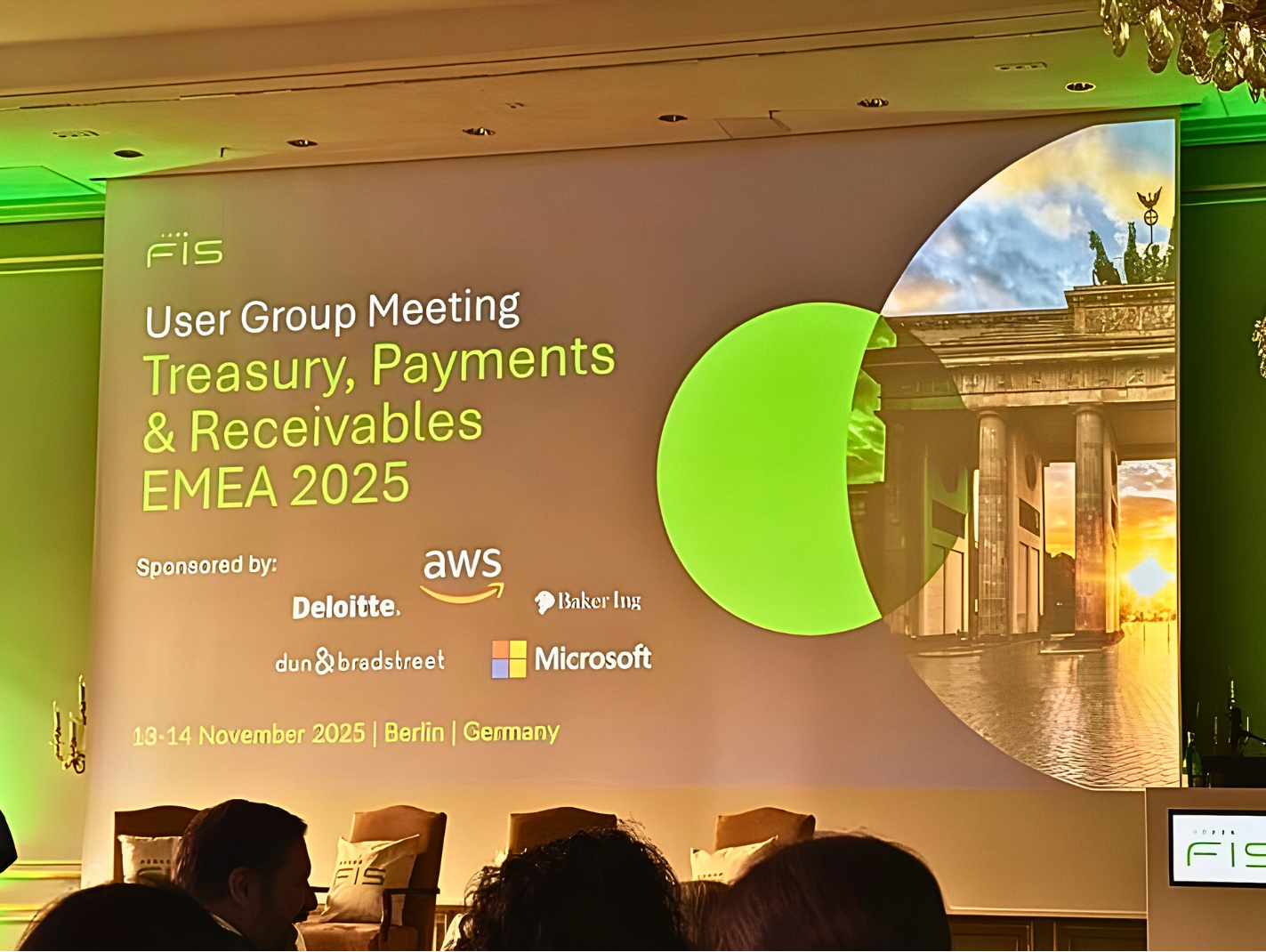
That theme ran through the FIS sessions. The centre of gravity is shifting from “automate a rule” to “let intelligence shape the work”.
With FIS GETPAID and Revenue Insight, we saw how receivables are moving beyond static dunning rules. Instead of sending the same reminder to everyone who is three days late, the system looks at behaviour and risk signals to decide where to focus, who is likely to cure, and who needs early intervention.
On the treasury side, Treasury & Risk Manager – Integrity Edition with “Treasury GPT” showed what happens when a treasurer can ask a direct question about cash, risk or configuration and get a coherent answer from the system. The job shifts from hunting for data to acting on it.
Nobody pretended the technology is perfect. But the direction of travel is obvious: intelligence is starting to drive the workflow, not just decorate it with reports.
The ecosystem is the real defence
Another clear signal from Berlin was that no single vendor can cover the whole risk-to-cash chain.
Dun & Bradstreet talked about combining global commercial data with workflow tools.
Microsoft and AWS focused on the cloud foundations needed to process and secure that data at scale.
FIS concentrated on how treasury and receivables platforms use it in practice.
This is where Baker Ing sits. Data and platforms can surface risk, but they do not resolve it. When a strategic client is under pressure, you still need negotiation, judgement and relationship management.
The companies that will cope best in 2026 will be the ones that combine:
- hard signals from data and models
- clear workflows in their core systems
- experienced people who can handle the edge cases
Test your assumptions with the Risk-to-Cash Explorer
Making sense of two intense days
Back in the office, we took the Berlin notes apart. Underneath the demos and case studies the same questions kept appearing. How do risk sensing, receivables, treasury, data and the operating model actually fit together? Where are the real choke points? How does the wider ecosystem of platforms, data providers and human expertise support or undermine that structure?
We captured those recurring themes in a five-pillar framework and then built the Explorer as a way to make that analysis usable. It lets a team step through the framework in a structured way and see which patterns from the event feel uncomfortably familiar and which feel aspirational.
But the point is not to score anyone. It is to make the relationships between capabilities, outcomes and ecosystem signals visible enough that serious conversations can start.
Scenario view: exploring Berlin’s moves
The scenario view takes the same Berlin framework and lets users experiment with it. The capability plays mirror the sorts of moves discussed at the user group. For example: more granular segmentation, better use of cash at risk analytics, tighter forecasting linked to receivables, centralised payments, or clearer data ownership.
Switching plays on and off does not claim to tell anyone what will happen in their numbers. It simply shows how those choices move the pattern inside the framework and how the balance between working capital, liquidity, credit risk, productivity and governance signals shifts as a result.
In other words, it turns two dense days in Berlin into something that can be explored, questioned and argued with inside a real business without pretending to be a full risk model.
Bringing it home
The message in Berlin was clear. The next cycle will be shaped by organisations that understand the relationships between their capabilities, not the ones that bolt on another tool and hope for the best. Risk, receivables, treasury, data and governance now move as one chain.
The companies that survive volatility will be the ones that can see that chain clearly and act on it.
Explore the insights: Risk-to-Cash Explorer (free tool)