
Most event reports tell you what the speakers said and at TransformO2C’s Elevate, it also tells you what the room said back.
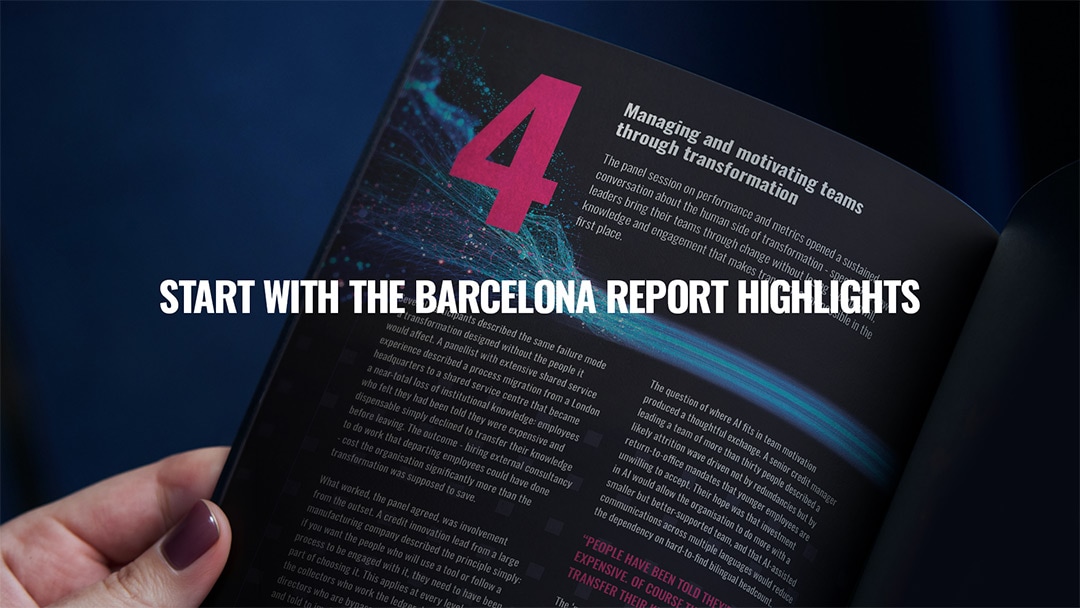
The O2C Transformation Forum in Barcelona brought together fifty senior credit, collections and shared services professionals for a day of peer exchange. What came out of it was a report that covers the conversations that rarely make it into conference write-ups – the unresolved questions, the honest disagreements and the specific, practical things that are working.
Here’s a preview of what’s in it and why the full report is worth an hour of your time.
The AI debate that went somewhere useful
The forum spent more time on AI than any other topic. The question was whether the function is ready for it, and the honest answer from the room was: not yet and not in the way the CFO thinks.
Fewer than a quarter of participants were actively hiring for AI-specific roles, despite almost universal board pressure to move faster. Most organisations are managing AI adoption through existing staff, without a governance framework, without a prompt library and without a clear policy on what data is permitted to enter which tools.
One partner described what happens when that gap is left unaddressed. Someone at a competitor firm uploaded a document to a public AI tool for some quick analysis. The document contained unreleased quarterly financials. Those numbers surfaced through the platform. The competitor had them before they were filed.
Nobody in the room found that surprising and that’s the problem.
The difference between automation and AI – and why it costs money to confuse them
A thread that ran through the day was the conflation of automation and AI at board level, and the practical consequences of letting it go unchallenged. Much of what is being sold as AI is, when you look closely, sophisticated rules-based automation.
This isn’t a criticism – automation solves a significant proportion of what O2C functions need. But implementing it under the wrong label means measuring it against the wrong expectations, justifying it on the wrong business case and, often, spending considerably more than necessary.
The report covers this in detail, including a specific example of a token-based billing switch that saw a major financial services firm burn through an entire month’s AI allocation in a single day. The cost models for agentic AI are still evolving, and most finance functions have not yet built the internal literacy to question them.
Where does the manager go
This was the question that generated the most uncomfortable pause in the room. If AI agents can coordinate workflows, flag exceptions and manage routine decisions, what’s the case for the middle management layer as it currently exists?
The report offers a practical framework for the finance leader who wants to make themselves harder to replace – built around influence, advocacy and the ability to land a message with senior people whose time is limited.
Nine days off DSO with the method
For those who want something more immediately actionable, the report includes a DSO reduction case study that’s specific enough to be very useful. A company post-acquisition, under pressure to cut DSO by ten days, achieved nine days through ledger segmentation and deliberate effort allocation – the external team on the highest-risk aged debt and the internal team focused on stopping current debt from ageing. Human relationship management was reserved for the accounts where it carried commercial weight.
One thing worth doing before you read it
Ask your team – informally, this week – what AI tools they’re currently using. Not the approved ones. The ones they’re using in the browser tab next to their inbox. Ask what data they have put into those tools. Ask whether they know where it went.
The answers will tell you more about your current exposure than anything in an audit report. And they will make the Barcelona report considerably more useful when you sit down with it.
Download the full report – find it on our Global Outlook page.