
Country Risk Is Operational Now. Credit Strategy Needs to Catch Up.
For too long, country risk has sat in a category that felt abstract — a geopolitical overlay to be flagged in footnotes, tracked in policy templates, or explained with reference to headlines in far-off capitals.
But for today’s credit and finance leaders, that framing is obsolete.
Country risk is no longer about political instability. It’s about operational blockage.
It’s your receivables trapped in the wrong legal framework.
It’s FX exposure creeping across your margin thresholds.
It’s enforcement dependent not on terms — but on venue.
And it’s happening right now in some of the world’s most stable, regulated economies.
Cross-Border Collections
A Different Kind of Event
Why This Matters Now
Over the last 12 months, we’ve seen a marked increase in region-specific slowdowns that are not easily attributable to customer behaviour or sector performance.
What’s emerging instead is a pattern of jurisdictional friction:
Disputes initiated in one country but escalated — or avoided — in another
Payment terms distorted by FX shifts that fall below internal trigger thresholds
Delays introduced through legal or procedural barriers — not commercial resistance
This is a new kind of credit risk. It’s not about insolvency. It’s about enforceability.
And it’s reshaping how companies should think about collections performance.
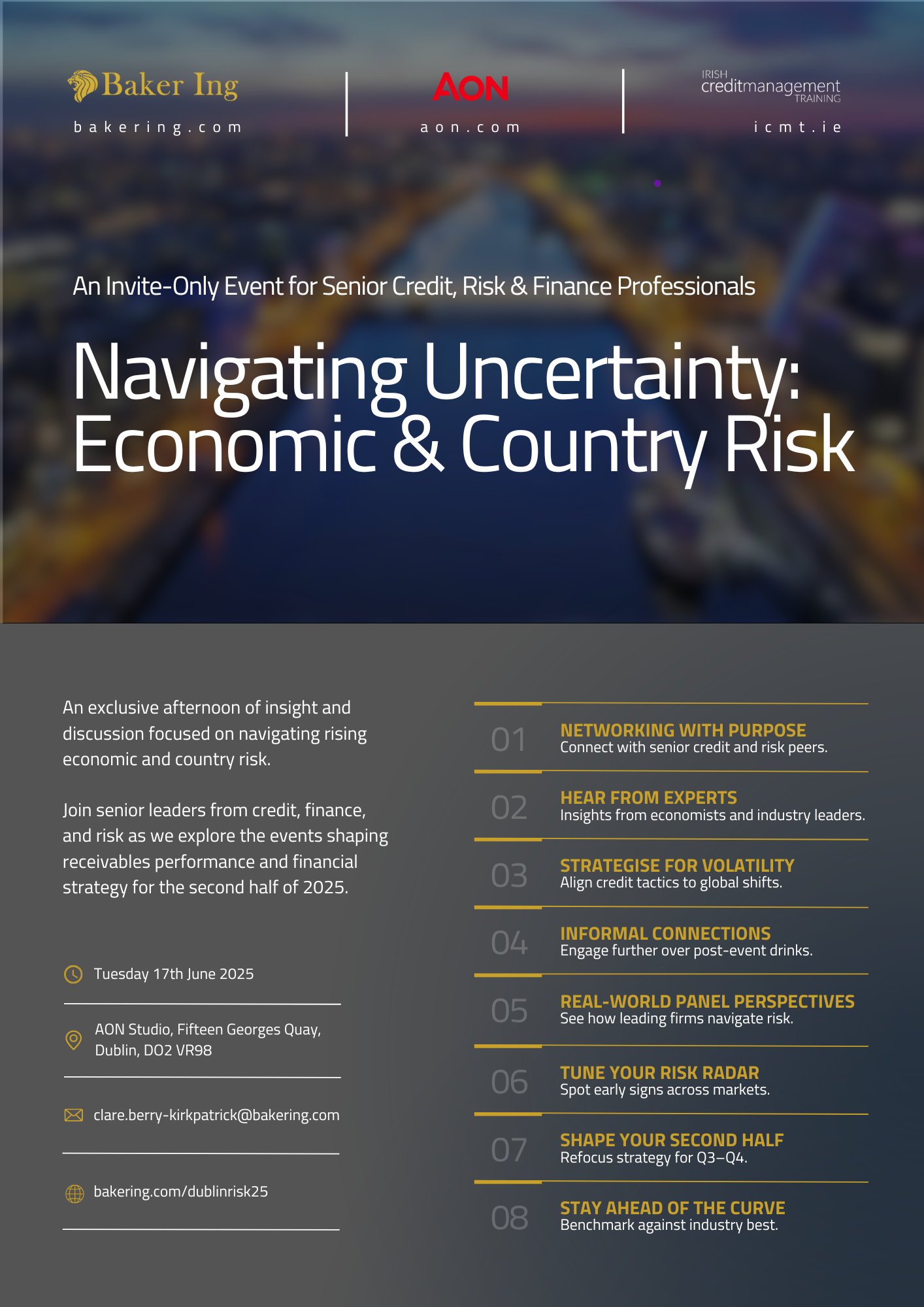
On 17 June 2025, Baker Ing, Aon, and ICMT are hosting a closed session in Dublin focused entirely on this reality:
Navigating Uncertainty: Economic & Country Risk
It’s not a typical industry event. There are no passive presentations or sponsor-led roundtables.
It’s a working session for senior leaders who already feel the impact — and need better ways to deal with it.
We’ll open with macro-level signals from Markus Kuger, Chief Economist at Baker Ing, then move straight into a panel of experienced credit operators:
- Baiba Gaigra (Ivanti)
- David Kearney (Ornua)
- Clare Roberts (Valeo Foods Group)
- Michelle McHale (Tayto Snacks)
They’ll share what they’re actually seeing across markets, how risk is showing up in receivables, and what changes are being made internally to protect cash.
The formal discussion will be followed by informal conversations over drinks at The Trinity City Hotel — continuing the dialogue between peers who are working through the same challenges.
The second half of 2025 will not get easier.
Macroeconomic stability is weakening, interest rates are stuck in a holding pattern, and insolvencies are still rising across multiple European markets.
But it’s not just macro exposure that needs attention — it’s the legal, financial, and procedural channels through which companies expect to recover value.
If those channels are clogged, inconsistent, or dependent on outdated assumptions, credit risk doesn’t just rise — it spreads sideways, infecting cash flow, working capital, and commercial flexibility.
Country Risk Must Become a First-Class Credit Input
What this means for practitioners is clear: country risk must move up the agenda.
It needs to be integrated into onboarding and collections workflows.
It needs to inform escalation thresholds and dispute handling protocols.
And it needs to be factored into where, how, and whether to enforce receivables.
This isn’t about becoming geopolitical analysts — it’s about operational reality.
If risk management doesn’t account for jurisdictional friction, it’s incomplete.
Request an Invitation
This Dublin session is by invitation only. If you lead credit, risk, or finance strategy in a business affected by cross-border friction — and you want to be in the room — contact Clare Berry, who leads Baker Ing’s work across Ireland and Northern Ireland:
Tuesday 17th June 2025
AON Studio, Georges Quay, Dublin
Drinks to follow at The Trinity City Hotel